Metal Roofing & Retrofits

What Is a Metal Roof Retrofit?

Metal roofing covers new or replacement panel systems on sloped roofs, plus the retrofit options for an existing metal roof. An aging metal roof with sound panels can often be recovered with a single-ply membrane, sprayed with foam or coated instead of torn off. Replacement makes sense when panels are rusted through or the structure needs repair.

Tear-off, overlay, or new construction — built to spec

Strong Contractors installs, replaces and restores commercial metal roofing systems, including functional and architectural assemblies. Metal roofing uses interlocking or mechanically seamed panels to create a durable, water-shedding sloped roof system. It is commonly selected for its long service life, resistance to severe weather, low maintenance requirements and architectural appearance.

Common Applications:
  • Commercial and Institutional Buildings
  • Schools and Municipal Facilities
  • Warehouses and Industrial Buildings
  • Steep-Slope Roof Areas
  • Canopies and Covered Entrances
  • Architectural Roof Sections
  • Equipment Shelters and Ancillary Structures
  • New Construction and Roof Replacement Projects
Strong Contractor's Approach to Metal Roofing

Coordinated for Movement, Drainage and Long-Term Weather Control

Metal roofing must remain securely attached while accommodating thermal movement and directing water through changes in slope and geometry. Strong coordinates the panels, clips, fasteners, underlayment, closures, sealants and flashings as one complete weather-control assembly.

  • Understand the Roof Geometry
    We review slope, panel layout, drainage paths, substrate conditions, penetrations and transitions before installation.
  • Plan Attachment and Movement
    Clip locations, fixed points and panel lengths are coordinated to permit controlled expansion and contraction.
  • Control Panel Installation
    Panel alignment, fastening, seaming and closure placement are managed continuously across the roof.
  • Resolve Complex Interfaces
    Valleys, curbs, walls, penetrations, eaves, ridges and terminations receive coordinated fabricated details.
Fit Check

Replace, retrofit or restore your metal roof?

Usually a Good Fit

  • Sloped roofs, canopies and architectural sections that need a water-shedding panel system
  • Panels are structurally sound but leak at seams or fasteners
  • You want to add insulation without removing the panels
  • Rust is on the surface and has not perforated the metal
  • The building has to stay open while the roof is addressed

Usually Not a Fit

  • Panels are rusted through or the supports are compromised (replacement first)
  • The slope is too low for the panel profile and water sits on the roof
  • Old coatings or heavy rust cannot be prepared to a sound surface
Our Process

Metal Roof Projects, Assessment to Closeout

Replace the panels or keep them? Every metal roof project turns on that question, and the steps below cover both paths.

  1. Assess Panels and Structure

    We check for corrosion, loose or backed-out fasteners, failed seams and sealants, and the condition of purlins or deck. That tells us whether the existing panels can stay.
  2. Choose the Path

    New panels, a single-ply membrane over the existing roof, spray foam or a coating restoration. The choice follows panel condition, insulation goals, budget and how long the owner plans to hold the building.
  3. Prepare the Surface

    For retrofits, rust is removed and treated, fasteners are tightened or replaced, and seams are sealed. For a membrane recover, the panel profile is filled or covered to create a flat base.
  4. Install in Phases

    New panels and trim, or the membrane, foam or coating, go on in phases so the space below stays protected from weather throughout the work.
  5. Verify and Document

    Fastener lines, seams, flashings and, on coatings, applied thickness are checked before closeout. You receive the warranty and a maintenance schedule for the system installed.
System Specs

Typical Metal Roof Specs and Retrofit Options

SpecTypical Value
New panel typesStanding seam (mechanically seamed) and interlocking panels
AttachmentConcealed clips with planned fixed points, or through-fastened panels
SlopeSloped, water-shedding roofs; minimum slope set by the panel manufacturer
Panel gaugeTypical: 24 or 22 gauge steel, set by design
Retrofit: single-plyMembrane over the existing panels on a leveled substrate
Retrofit: spray foamFoam applied over the panels, then protected with a coating
Retrofit: coatingFluid-applied coating over prepared panels, seams and fasteners
Pricing

What Drives the Cost

The biggest cost decision on a metal roof is whether the existing panels stay. After that, these factors drive the number.

  • Panel Condition

    Surface rust costs far less to address than perforated panels, which have to be replaced before any retrofit goes on.

  • Replacement or Retrofit Path

    New panels, a membrane recover, spray foam and coatings differ widely in material, labor and expected service life.

  • Insulation Target

    Adding insulation through spray foam or a recover board raises cost now and can lower energy use over the life of the roof.

  • Fabricated Trim and Details

    Custom flashings at eaves, ridges, valleys, walls and penetrations add shop and field labor, especially on architectural roofs.

  • Access and Occupancy

    Roof height, slope, equipment and work over occupied space affect safety setup, staging and schedule.

Compare Options

New Metal Panels vs. Spray Foam Over Metal vs. Silicone Restoration

Metal Roofing & RetrofitsSpray Foam (SPF) RoofingSilicone Roof Coatings
Existing panelsRemoved and replacedStay in placeStay in place
Adds insulationOnly if added under new panelsYes, the foam insulatesNo
Seams and fastenersNew seams and clipsCovered by seamless foamSealed, then coated
Panel condition neededStructure must be soundSound panels, rust treatedSound panels, surface rust only
DisruptionHighest; roof is openedLow; no tear-offLowest
Typical fitFailed panels or new designLeaking, uninsulated metalAging but sound panels
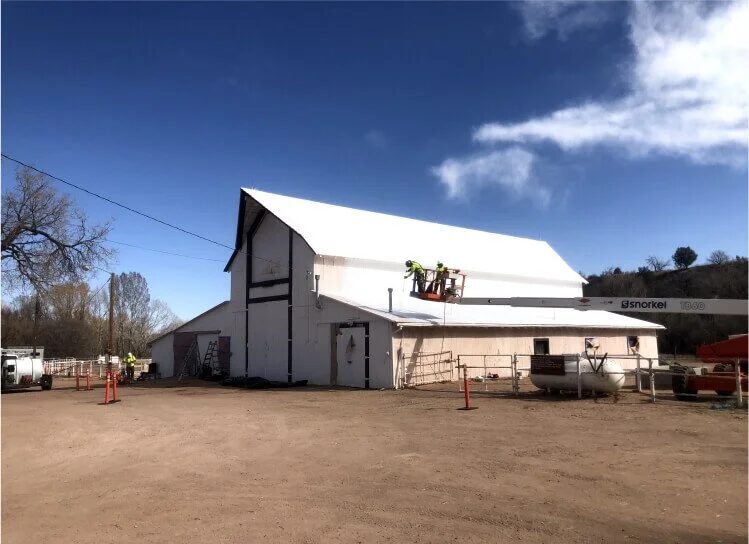
Historic Fort Carson Mounted Guard barn during the silicone roof coating work
Featured Project

Fort Carson Mounted Guard

Silicone coating restoration of the historic Mounted Guard barn at Fort Carson, completed in partnership with the Army Corps of Engineers.
Fort Carson, CO
View Case Study
FAQ

Metal Roofing and Retrofit Questions

Can you put roof coating on a metal roof?

Yes, on panels that are still sound. The coating seals seams and fasteners and covers the surface with a continuous, weather-resistant layer. Preparation decides how long it lasts: rust is removed and treated, loose fasteners are tightened or replaced, and seams are reinforced before the coating goes on.

How long does a coating last on a metal roof?

The manufacturer warranty quoted for your roof is the most reliable guide, because terms are tied to the coating system and the thickness installed. Coating type, applied thickness and panel prep all affect how long it performs. A coated roof can usually be recoated later instead of replaced.

What is the difference between roof sealant and roof coating?

Sealant is a spot treatment that closes a specific seam, joint, fastener or crack. A coating covers the whole roof surface with a continuous membrane. On metal roofs, sealant at seams and fasteners is usually part of the preparation, and the coating then goes over everything.

Can a flat roof membrane be installed over a metal roof?

Yes. A single-ply metal retrofit puts a membrane over the existing panels without a tear-off. The panel ribs are usually filled with insulation or covered with a board to create a flat surface, and the membrane is attached over it. The retrofit can add insulation and cover exposed fasteners with one continuous layer.

Can spray foam be applied over a metal roof?

Yes. Spray polyurethane foam bonds to prepared metal, fills the panel profile and covers seams and fasteners in one seamless layer that also insulates. A protective coating goes over the foam. Strong is an SPFA Accredited Contractor, and metal is one of the substrates the team sprays.

Why does my metal roof leak at the screws?

On through-fastened panels, the rubber washers under each screw age and crack, and daily expansion and contraction can loosen fasteners. Water then follows the screw into the building. Replacing or resealing fasteners fixes isolated leaks; leaks across the whole roof usually mean it is time for a retrofit.

Should I replace my metal roof or retrofit it?

If the panels and supports are sound, a retrofit usually costs less and keeps the building closed to weather during the work. Replacement makes sense when panels are rusted through, the structure needs repair, or the slope or design no longer works. A roof assessment answers the question before either option is priced.

Related Services

Explore More Commercial & Industrial Roofing Solutions

TPO Roofing Systems

Read More

EPDM Roofing

Read More

PVC Roofing Systems

Read More

Built-Up Roofing (BUR)

Read More

Modified Bitumen Roofing

Read More