Built-Up Roofing (BUR)

What Is Built-Up Roofing (BUR)?

Built-up roofing (BUR) is a multi-ply, low-slope roof assembled on site from layers of reinforcing felt and bitumen, then finished with gravel, a cap sheet or a coating. It suits roofs that take heavy foot traffic, carry a lot of equipment or need redundancy against punctures. It is a strong choice when the structure can carry the weight and the building can tolerate hot work or odor.

The original built-up roof, engineered for today's buildings

Strong Contractors installs, replaces and repairs built-up roofing systems for commercial, industrial and institutional facilities. Built-up roofing, commonly called BUR, uses multiple reinforcing plies bonded with hot asphalt or an approved cold-applied adhesive and finished with aggregate, a cap sheet or another protective surfacing. It is commonly selected for its puncture resistance, traffic tolerance and long history of performance on demanding low-slope roofs. ‘

Common Applications:
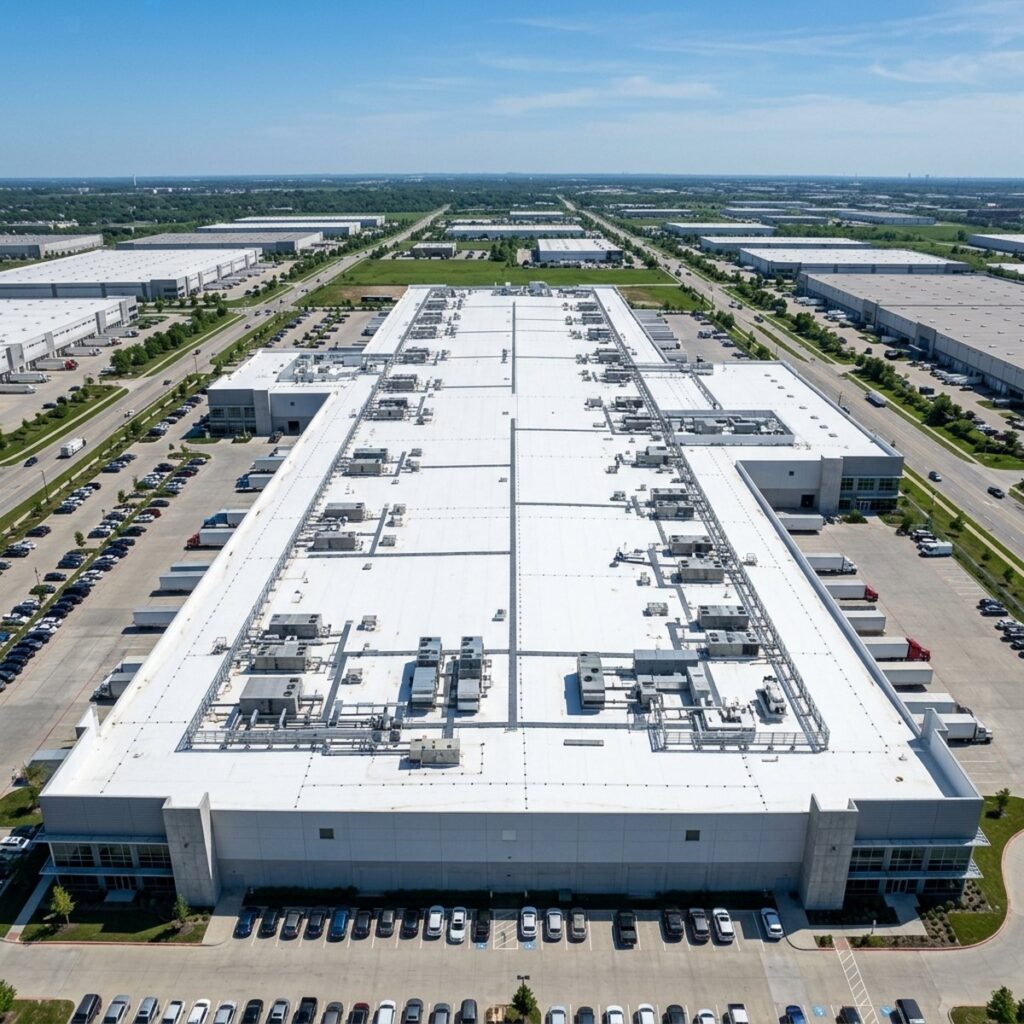
  • Industrial and Manufacturing Facilities
  • Schools and Institutional Buildings
  • Hospitals and Healthcare Facilities
  • Commercial Buildings
  • High-Traffic Roof Areas
  • Roofs with Extensive Mechanical Equipment
  • Roofs Requiring a Durable, Multilayer Assembly
  • Complete Replacement and Phased Reroofing Projects
Strong Contractors' Approach to Built-Up Roofing (BUR)

Built Layer by Layer for Continuity and Redundancy

Built-up roofing develops its strength through multiple reinforcing plies bonded with bitumen and protected by a finished surfacing. Strong controls each layer as it is installed because deficiencies in asphalt application, ply placement or adhesion can become concealed as the assembly is built.

  • Understand the Existing Conditions
    We evaluate the substrate, insulation, drainage, traffic demands and roof configuration before beginning the assembly.
  • Control Bitumen and Ply Placement
    Asphalt or approved adhesive is applied consistently while plies are embedded, lapped and offset.
  • Maintain Multi-Ply Continuity
    Laps, flashings and reinforced conditions are integrated without aligning weaknesses through the membrane.
  • Complete the Protective Surface
    Aggregate, cap sheet or coating is installed to protect the finished membrane from weathering and physical damage.
Fit Check

Is a built-up roof right for your building?

Usually a Good Fit

  • The roof carries heavy mechanical equipment and frequent service traffic
  • You want several layers of protection, so one puncture does not reach the deck
  • The specification or owner standard calls for a multi-ply bituminous system
  • The existing roof is BUR and the deck, drainage and structure are already designed for it
  • Hail and dropped tools are a real risk on the roof

Usually Not a Fit

  • The structure cannot take the added dead load of gravel surfacing without reinforcement
  • Hot asphalt fumes would reach air intakes or occupied spaces you cannot shut down
  • The roof is steep enough that aggregate surfacing will not stay in place
  • The existing BUR is dry and sound, so a restoration may cost less than a rebuild
Our Process

From Core Samples to Closeout

A built-up roof goes together one ply at a time, in the field, with crews, kettles and weather all in play. This is the usual sequence.

  1. Survey the Roof and Take Cores

    We walk the roof and check drains and equipment, then cut test cores to see what is under the surface. The extent of wet insulation and deck damage sets much of the scope.
  2. Decide: Repair, Restore or Rebuild

    A BUR with dry insulation is often a candidate for spot repairs or a restoration, like the foam and coating system we used over an existing tar-and-gravel roof. Wet or failing assemblies come off.
  3. Plan Kettles, Fumes and Access

    We place asphalt kettles and hoists away from air intakes, doors and loading areas, and set work zones so occupants, deliveries and operations keep moving while the roof is open.
  4. Tear Off and Dry In Daily

    Old roofing comes off only in sections the crew can finish that day. Every open area is sealed watertight before the crew leaves, so weather never reaches the building interior overnight.
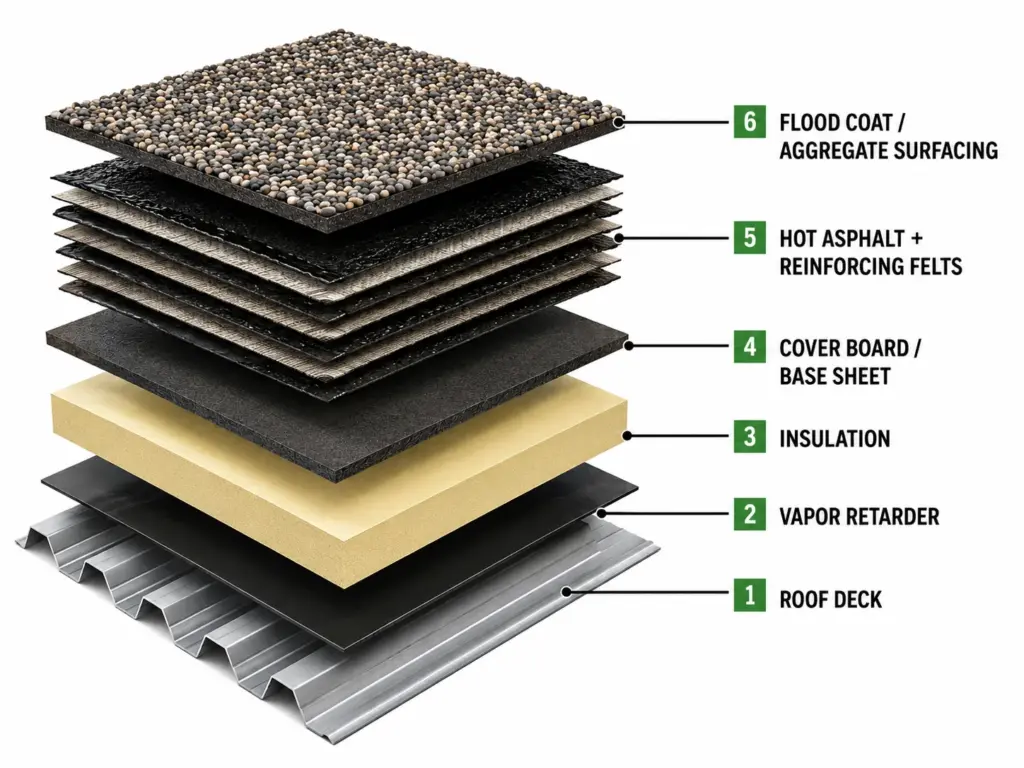
  5. Build the Plies and Flashings

    Insulation, base sheet and reinforcing plies go down in staggered courses, followed by base and counterflashings at walls, curbs, drains and penetrations to tie the field into every edge.
  6. Surface, Inspect and Document

    Gravel, cap sheet or coating goes on last. We walk the finished roof, close out the punch list and hand over QA/QC records and warranty paperwork.
System Specs

Typical Built-Up Roof Specs

SpecTypical Value
PliesTypical: 3 to 4 reinforcing plies over a base sheet
BitumenHot-mopped asphalt or an approved cold-applied adhesive
SurfacingAggregate (gravel), mineral cap sheet or coating
Roof slopeTypical: low-slope, minimum 1/4 in. per ft for new roofs
Added weightTypical: about 4 to 6 lb per sq ft with gravel surfacing
Service lifeTypical: 20 to 30 years with routine maintenance
WarrantyNo Dollar Limit (NDL) manufacturer warranties, typically 10 to 20 years depending on the system
Built-up roof assembly layers: roof deck, vapor retarder, insulation, cover board or base sheet, hot asphalt and reinforcing felts, flood coat with aggregate surfacing
Pricing

What Drives the Cost

Built-up roofing is labor-intensive, so the price follows how much has to come off, how many plies go on and how hard the roof is to reach. These factors move it most.

  • What Is Under the Old Roof

    Wet insulation, rotted deck or multiple old roof layers all add removal and replacement work. Core samples tell us early, before the bid is final.

  • Number of Plies and Surfacing

    A four-ply gravel roof uses more material and crew hours than a three-ply cap sheet roof. The specification and the traffic on the roof decide which one fits.

  • Hot or Cold Application

    Hot asphalt needs kettles, fuel and fume control. Cold-applied adhesives avoid that but cost more per gallon and cure more slowly in cool weather.

  • Access and Staging

    Crane or hoist access, building height, limited laydown space and work around occupied areas all change how fast material moves to the roof.

  • Equipment and Penetrations

    Every curb, pipe, drain and wall needs flashing by hand. A roof crowded with mechanical units is priced higher per square foot than a clear, open field.

Compare Options

BUR vs. Modified Bitumen vs. Spray Foam

Built-Up Roofing (BUR)Modified Bitumen RoofingSpray Foam (SPF) Roofing
How it is built3 to 4 plies bonded in the fieldFactory-made sheets, usually 2 pliesFoam sprayed in place, then coated
SeamsStaggered laps through every plySide and end laps per plySeamless
Tear-offUsually, for a full replacementUsually, for a full replacementOften not, over a dry, sound roof
Traffic and punctureHigh, especially with gravelHigh with a granule cap sheetGood; walkways for heavy traffic
InsulationSeparate insulation boardSeparate insulation boardFoam adds insulation value
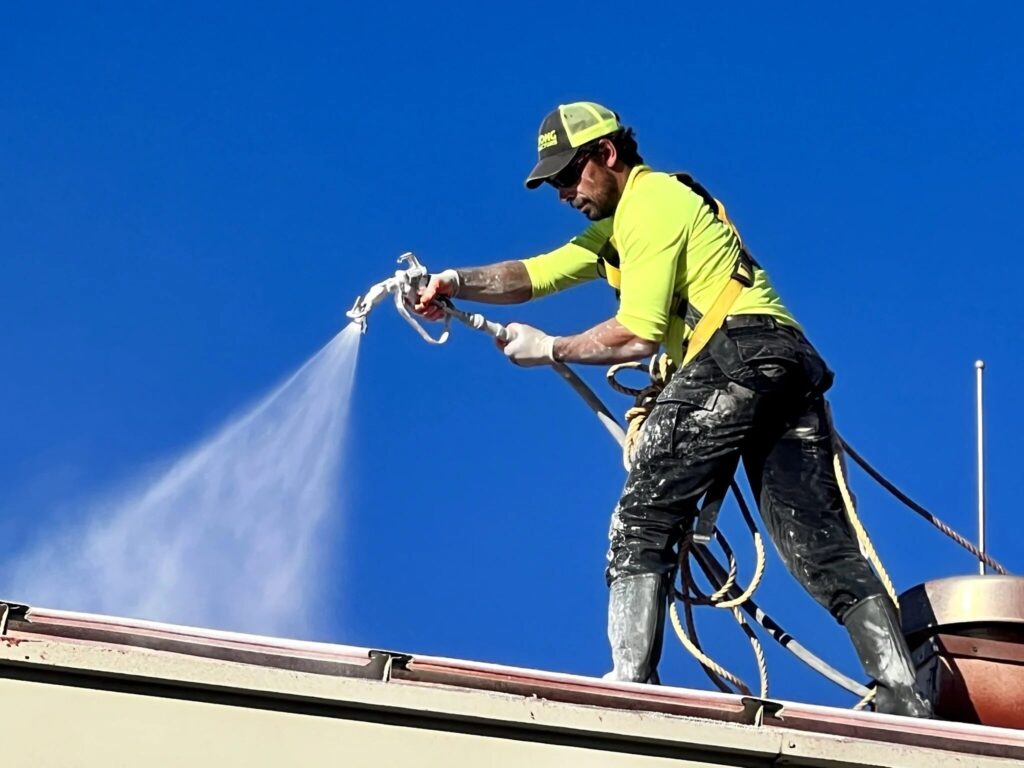
Applicator in safety gear spraying coating at a roof edge
Featured Project

Eglin Air Force Base

Multiple facilities, including a data center and an ammunition facility: gravel removed from the tar and gravel roofs, then spray foam insulation and a granule-surfaced urethane coating.
Eglin Air Force Base, FL
View Case Study
FAQ

Built-Up Roofing Questions

Is built-up roofing the same as tar and gravel?

Yes, a gravel-surfaced built-up roof is what most people call tar and gravel. Modern BUR is usually built with asphalt rather than coal tar, and it can be finished with a mineral cap sheet or a coating instead of loose gravel. The structure underneath is the same: several reinforcing plies bonded into one membrane.

How long does a built-up roof last?

A well-installed built-up roof typically lasts 20 to 30 years with routine maintenance. The number of plies, the surfacing, drainage and how well flashings are kept up all change that range. Ponding water and neglected flashings shorten it fastest. A core sample and inspection tell you where your roof sits today.

Can you spray foam or coat over an existing built-up roof?

Often, yes, when the plies are well bonded and cores show dry insulation. On our Eglin Air Force Base work, the existing built-up roof stayed in place: the crew cleared off loose gravel, then sprayed foam and a granule-surfaced urethane coating over it. Wet insulation has to come out first, so we take cores before recommending this route.

Is a gravel roof too heavy for my building?

It can be. Gravel surfacing typically adds about 4 to 6 pounds per square foot, and older buildings were not always designed with a margin for more. If a new roof would add layers or weight, have the structure reviewed first. A cap sheet or coated surface is a lighter BUR option.

Will hot asphalt fumes get into my building?

They can if the work is not planned for it. We place kettles downwind and away from air intakes, coordinate with facility staff on HVAC settings and schedule work around sensitive areas. Where fumes are not acceptable, such as some hospital or lab settings, a cold-applied BUR system is an option.

Should I repair or replace my built-up roof?

Repair if the problems are local and the insulation underneath is dry. Replace when moisture has spread through the assembly, the plies are blistering or splitting widely, or repairs keep failing in the same areas. Between those two, a restoration over the existing BUR can add service life while the plies stay in place.

Related Services

Explore More Commercial & Industrial Roofing Solutions

TPO Roofing Systems

Read More

EPDM Roofing

Read More

PVC Roofing Systems

Read More

Metal Roofing & Retrofits

Read More

Modified Bitumen Roofing

Read More